Friday, June 30, 2023

The Battle for Dublin Springs

     If you have read previous articles on this blog, you know that Fairfax has sometimes had an image problem. In the 1920s, local government officials called Fairfax a “rural slum” and a “settlement of poor persons in little homes.” Back then, we were known as “Dogtown.” In the 1950s, a school board member from Mariemont complained that residents of other areas of the district were “paying the freight” for the children of Fairfax. A few years ago, someone even posted on the Fairfax, Ohio Wikipedia page that we were “the armpit of the Mariemont School District,” an entry that has since been deleted. If you have lived here very long, you know. You have heard it all before.

     Before we get on our high horses, though, there are a couple of areas within the village that some residents have at times overlooked, ignored, and, frankly, looked down upon. One of those areas is Dublin Springs, the subdivision that includes the south side of Wooster Pike, Spring Street, Eleanor Street, Mary Street, Arrow Point Way, and, at one time, Riverview Drive.

Hamilton County CAGIS map. Dublin Springs is on the southern side of Wooster Pike

    Both of my parents lived on Spring Street for a while when they were children. More family members and friends lived on Eleanor and Spring Streets through the years. In the early 1970s, my aunt watched my sister, brother, and me at her family's Spring Street home while my parents were at work. I have a lot of childhood memories of playing in the area with my cousins, like hanging out in the clearing at the end of Riverview Drive, walking to King Kwik for some candy, and dumpster diving at the Dragon Way office buildings. Perhaps the most iconic childhood experience in that area in those days, though, was going to a rear fence of Keebler (previously Strietmann’s and now Kellogg’s) and calling for the workers to toss you some cookies. I have been told in earlier days they would give away bags of broken cookies. However, I seem to recall receiving full, intact packages.

     As far as I recall, no one called the area Dublin Springs. I called it “the other side of the Pike,” until my mom told me that sounded derogatory. I never thought of it being derogatory, though; I thought it was just a description of where it was located in relation to the rest of Fairfax. It was a secluded little neighborhood and, to me, had sort of a rural feel.

     Enough of my reminiscing!

     The Dublin Springs subdivision was platted in April 1913:

Dublin Springs plat, Hamilton County Recorder's Office

    In an August 1913 newspaper ad, Robert Cresap, the real estate developer behind Dublin Springs,  described Lot 1 in the subdivision as follows: “It has seven springs, fine sand and gravel bank; fine for trucking; make a fine chicken or truck farm.” Cresap also suggested the location for a grocery for the small, but growing, Fairfax Subdivision, or a hotel or roadhouse for the 300 to 500 drivers who passed the location each day. Instead of becoming a farm, grocery, or hotel, Lot 1 was divided into smaller lots and became Spring Street and the western portion of Eleanor Street.

     Other than the Joseph Ferris House, the original Dublin Springs structure (see The Joseph Ferris House), the oldest houses I found in the subdivision were built on Wooster Pike and Mary Street in 1915. One of the Wooster Pike houses is still standing and the other, after several additions and modifications, is now Mac’s on the Pike. The Mary Street house has since been torn down. There may have been earlier homes in the subdivision that are no longer in existence.

     The first public school in Fairfax opened in Dublin Springs in 1918, at the corner of Spring Street and Wooster Pike, where Honest-1 Auto Care is now located. The most prominent of the springs in Fairfax was located behind the school and was the source of drinking water for the school and surrounding neighborhood. And, yes, Spring Street received that name because of the nearby spring.

     In the 1920s, the Fairfax and Madison Heights Subdivisions received water, sewage, and gas lines. I haven’t been able to determine exactly when the various sections of Dublin Springs received water and gas lines. My mom remembers that her family had water and gas service on the north section of Spring Street when they lived there in 1949. However, a couple of women who lived at the south end of Spring Street reported in a 1951 Cincinnati Times-Star article that they did not have water service and had to get water from neighbors. Dublin Springs did not have storm or sanitary sewage service like the rest of the village; their homes had septic tanks. Also, Dublin Springs didn’t receive door-to-door mail delivery until the mid-1950s, after the rest of the village.

Cincinnati Post, April 9, 1942. There were no storm sewers to handle the water
from heavy rains.

    In 1955, Fairfax residents, including those in Dublin Springs, voted by a 9 to 1 margin to incorporate as a village. The following year, voters approved a $1.4 million bond issue for street improvements. By 1961, nearly $1.1 million in bonds had been issued when the Ohio Supreme Court stopped the village from issuing any additional bonds for the street improvement project until the village’s tax duplicate was higher. Village Clerk Virmorgan Ziegler speculated that the remaining $300,000 might not be enough to complete the project anyway, since construction costs had increased in the past five years. No improvements had been made to the Dublin Springs Subdivision.

     In December 1961, Mayor Ralph Mitchell announced a plan to apply for federal urban renewal funds for redevelopment of Dublin Springs, proudly announcing that Fairfax would be the first suburb in Ohio to do so. The federal Housing Act of 1949 sparked the urban renewal movement, providing for "the elimination of substandard and other inadequate housing through the clearance of slums and other blighted areas, and the realization as soon as feasible of the goal of a decent home and a suitable living environment for every American family." It sounds like a good idea, I guess, unless you live in the area of the proposed renewal and are happy there.

Fairfax Mayor Ralph Mitchell from 1959 campaign advertisement.

    Of Dublin Springs, Mayor Mitchell said, "Most of the houses there are substandard, although there are some that meet standards or are above standard." He said it was “impractical to make the improvement for residential use” and that the area was better suited to commercial or industrial use. The plan would involve moving the 50 or so families in Dublin Springs. Mitchell said the federal government would probably insist that the displaced residents be relocated to other homes in Fairfax. He estimated an urban renewal plan for Dublin Springs would cost around $400,000. The idea was only in the planning stage, though, and council hadn’t yet voted on it.

     On December 12, 1961, Mayor Mitchell met with some concerned Dublin Springs residents at the home of Norman Yeager on Spring Street. These residents did not support the project and had no interest in moving. The residents expressed their frustration because they were told that they would get new sewers and streets if they incorporated with the rest of the community, but hadn’t. Mr. Yeager said, “Then we voted for a bond issue to improve the village’s streets, but all of the improvements have been on the other side of town. We haven’t gotten any, but our taxes went up . . . to pay for the bond issue.” Mitchell explained that the village had already spent all of the funds from the bond issue elsewhere in the village and that improvements to Dublin Springs streets would be too expensive. Despite the Dublin Springs residents’ opposition, Mitchell said the village would likely proceed with the project.

     Over 30 Dublin Springs residents attended the December 20, 1961 council meeting to voice their opposition to the urban renewal plan. Nevertheless, several weeks later, council cleared the way for federal officials to conduct a field survey of Fairfax for urban renewal purposes. The council vote was three to three, with Mayor Mitchell casting the deciding vote in favor of proceeding with the plan. Council applied for a federal grant for a study of Dublin Springs. The study would take around a year to complete.

     In April 1962, Fairfax council member Joseph White, at the urging of Arrow Point Way resident Ralph Meisberger, introduced a motion to drop the urban renewal plan. Again, the council vote was three to three with Mayor Mitchell casting the deciding vote to defeat White’s motion.

     In early May, Fairfax received federal approval for the urban renewal project. With this, the village was eligible to apply for a federal planning grant for a land use study of Dublin Springs. Once the study was competed, the village would need to decide whether to rehabilitate the area, clear and redevelop the area, or drop the project altogether.

     Some village officials wanted the urban renewal project placed on the ballot to gauge resident sentiment on the issue. This was never necessary, as it turns out. Council member Edward Steele, who had been a staunch supporter of the urban renewal project, resigned from council on May 14, 1962 when he accepted a state civil service job.

     At the May 15, 1962 council meeting, Joseph White introduced a motion to not move forward with the federal urban renewal project. The motion passed by a three to two vote. White and fellow council members Harry Davis and Wayne Nichols voted to abandon the project. Ronald Cribbet and Charles Schuler voted against the motion. The Cincinnati Enquirer reported that Fairfax’s rejection of federal urban renewal funds was believed to be the first in the history of the program.

     Joe White acknowledged that the grant the village had rejected was only for a land-use study, which could take at least a year, but regarding the Dublin Springs residents he said, “How would you like this thing hanging over your head for a year?” He said he was against relocating the Dublin Springs residents. He said he was against always “running to the government to solve a problem” and also believed that the power of eminent domain had gone too far, both in Fairfax and elsewhere. He felt that efforts to rehabilitate the area should be handled locally, rather than at the federal level. White proposed a committee to study installation of sewer lines and construction of new streets with funding supplied by a new bond issue. White said, "I think if those people got sanitary sewers and new streets, that would be an incentive to them to improve their property."

     John Pfister, a Dublin Springs resident and opponent of the urban renewal proposal, was appointed to council to fill the vacancy created by Edward Steele’s resignation. The anti-federal urban renewal faction on council now held a four to two majority. In June 1962, Mayor Mitchell appointed a committee of three council members to study improvements to Dublin Springs. Later that month, Ralph Mitchell resigned as mayor effective July 1, 1962 because he was moving out of the village. Council member Ronald Cribbet was appointed mayor.

     In July, council announced that a $175,000 bond issue for sewer, street, curb, gutter, and sidewalk construction in Dublin Springs would be on the November ballot. Ralph Meisberger chaired a house-to-house campaign to garner support for the issue. The bond issue passed. In December the village also asked county commissioners for $39,000 for sanitary sewer construction. Village officials wrote, "It is our belief this sewer should have been constructed many years ago when other sewers were installed in the area by the county, and therefore constitutes a responsibility of the county, irrespective of the fact that the village of Fairfax is now incorporated."

    Of course, projects like this feel like they take forever. Initially, the village had three sewer options to evaluate. Then in March 1964, village officials reported that they were still working on one more easement in Dublin Springs in order to begin work. In May, the village awarded the $112,000 project to the low bidder, Carter Construction, and work soon began. Unfortunately, in October 1964, two Fairfax boys disappeared and there were concerns that they may have been buried in an open sewer trench on Eleanor Street. The trench was re-excavated and nothing was found. In February 1965, the Hamilton County coroner and village residents expressed concern that not enough of the trench had been searched. In March 1965, more of the trench was re-excavated with no trace of the boys.

From the March 25, 1965 Cincinnati Enquirer

    Finally, Dublin Springs received storm and sanitary sewers and new streets, sidewalks, curbs, and gutters.

     Since then, several of the homes in the Dublin Springs have been torn down. New ones, including the condominiums on Arrow Point Way, have been built. In the late 1970s, Keebler purchased all of Riverview Drive and the houses at the south end of Spring Street, including my uncle and aunt’s home, and razed them.

     As I was writing this article, I realized that it had been around 40 years since I had been to Spring and Eleanor Streets. I visited on a weekday in the spring. It was quiet and a couple of residents were taking advantage of the nice weather to do some work in their yards. 

Eleanor Street looking east from Spring Street, 2023

Eleanor Street looking west from Spring Street, 2023

Spring Street looking north from Eleanor Street, 2023

    The area was much the same as I remembered it, until I got to the south end of Spring Street. Several homes were gone, including my uncle and aunt’s house and the Whitney house next door, replaced by a parking lot:

Southern end of Spring Street, 2023

    The former Riverview Drive, which ran perpendicular to Spring Street at its southern end, was locked behind the Kellogg’s gates:

Looking east in the area where Riverview Drive once was, 2023

    Although it is sad to see the changes made since my youth, I’m glad that this little neighborhood within a neighborhood is still thriving. Below are pictures from the 2023 Eleanor Street Fourth of July block party:


Block party photos courtesy of Tonya Moore.


Wednesday, May 31, 2023

The Grocers

     I originally planned this article to be a profile of several of the early business owners in Fairfax. However, in the course of my research I realized that I had found much more information about one business and its owners than I had for others. It was a business that I didn’t really know anything about until I started researching Fairfax history because Yochum’s Food Shop was out of business by the time I was born.

     Ethel Mae Carr was born in 1900 in Highland County, Ohio and Karl Everett Yochum was born in Highland County a year later. This was a rural area and both Ethel’s and Karl’s families had farms. Ethel’s father also managed a general store. In 1924, Ethel and Karl married in Highland County, then moved to the Cincinnati area. They initially lived in Madisonville, then moved to Norwood. By 1930, Karl was managing a grocery store in Madisonville.

     In October 1931, a man named William Lopacher opened a grocery at 6012 Wooster Pike in Fairfax. Within a couple of months, he sold the store to Karl and Ethel Yochum.

     Grocery shopping back then was much different than it is now. Stores were more specialized. There were dry goods stores, butcher shops, fish stores, and dairy dealers. Also, although a few self-service stores began around 1916, most stores were full-service, meaning that a customer would place their grocery order by phone or provide a shopping list and clerks would prepare the order for pickup or delivery. By the 1930s, some stores started offering both groceries and meat, and supermarket chains, like Kroger and Albers, were starting to grow in popularity.

Interior of Yochum's Food Shop from A History of the Village of Fairfax 
by Elizabeth Steele and Patricia Kuderer. It appears that Karl and Ethel are pictured
at right and the store's butcher at left.

    I would be remiss if I didn’t mention that there were other groceries in Fairfax. I do remember some of the other ones. The Fairfax Food Shop (which had a number of names and owners over the years) was located at the corner of Germania and Hawthorne, where the municipal parking lot is now. Watterson Market (known as Clark & Melvin in earlier days) was located at Watterson and Elder where Fairfax Lock and Key is now. Although it was technically in Mariemont, Brueckner’s was at the corner of Wooster and Settle. My family patronized all three of these stores. There were apparently even more grocery stores in the early years.

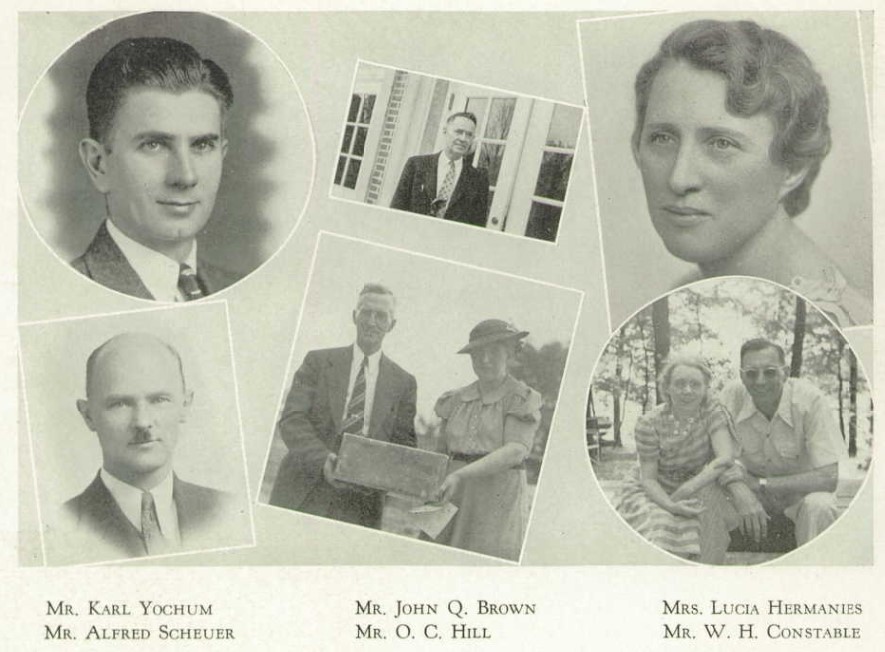
     Although the Yochums set up shop in Fairfax, they never, to the best of my knowledge, actually lived in Fairfax. In the late 1930s, they purchased a home on Settle Road in Mariemont. They were very much part of the Fairfax community, though. Yochum's sponsored local baseball teams and Karl even played on a Fairfax team himself. Karl was on the Plainville Rural School District Board of Education from the 1930s to the early 1940s. During his time on the Board, Plainville High School (now Mariemont Elementary) was constructed.

Karl Yochum (upper left) and other members of the Plainville Rural School District Board of 
Education from the 1941 Plainville High School Yearbook

    Now, Fairfax history nerd that I am, what really convinced me to do an article on the Yochums was having an opportunity to view some great old relics from the store. Some of these are receipts from other historic Cincinnati-area businesses with which Yochum's did business. Here are a few:

A 1937 receipt from our own Fairfax dairy, The J. H. Berling Dairy Products Company.


Do you remember Rubel's Rye Bread? 


A 1932 receipt from The Niser Ice Cream Company


Does anyone remember Mannino's Groceries in Madisonville? They were among 
Yochum's suppliers.


A Strietmann Biscuit Company receipt (for Toyland Animals and Zesta Crackers)
before Strietmann relocated to Mariemont. 


"Put it on my account!"
This appears to be a listing of Yochum's credit accounts from August 1937.


Remnants of an egg carton from Yochum's Food Shop.


Paper grocery bag from Yochum's Food Shop

    In 1946, the Yochums remodeled their store, giving it a brighter appearance. The store got a good cleaning and the walls were painted. A new 18-foot display counter was installed, giving customers a better view of and access to the merchandise. The biggest change was that the store converted to self-service. However, Yochum’s continued to offer clerk service to anyone who wanted it and still offered delivery three days a week.

Ad for Yochum's Food Shop from The Messenger, March 22, 1946

    Karl was an active member of the Cincinnati Retail Grocers and Meat Dealers Association for many years, serving as a director, vice president, and then president. Among the Association’s programs was the popular Pure Food Show that was held for two weeks at the Cincinnati Zoo each summer. The show featured booths, performances, cooking and homemaking classes, fashion shows, baby contests, and live radio broadcasts. Karl was often on the Show Committee.

     Ethel was a member of the Ladies’ Auxiliary of the Retail Grocers and Meat Dealers Association and served as president of the Cincinnati, Ohio State, and National organizations. As a member of the Ladies’ Auxiliary, Ethel participated in activities including selling war bonds on Fountain Square and delivering Christmas toys to patients at Children’s Hospital.

     The Yochums were also members of Fairfax Presbyterian Church. Karl helped to organize Boy Scout Troop 272, which was sponsored by the church. Karl was also involved in the Presbyterian Men of Cincinnati and was the director appointed by the Fairfax Church.

     After Fairfax incorporated as a village in 1955, business owners organized a Chamber of Commerce with Karl Yochum as the first president. He was also a director of the Fairfax Welfare Association. When the Fairfax Volunteer Fire Department was organized, Karl joined. Later in life he was a member of the Fairfax Senior Citizens Club.

Harry Nutick (left) and Karl Yochum (right) cleaning the fire engine
after a run. From the Cincinnati Post and Times Star Volunteer Firemen's Edition, 1960.

    In March 1957, Yochum’s had a 25th anniversary celebration, which included giveaways. A local newspaper, The Messenger, published an article about Karl, saying "He has seen the same persons come in for a sucker or a bubble gum, later pencils and tablets for school, and eventually a basket of groceries for a new family."

Ad from The Messenger, February 17, 1956


    The grocery industry was evolving and between 1948 and 1963, the number of supermarkets in the United States tripled. Small independent local grocers like Yochum’s found it hard to compete with large chains. I’m not sure if it was a financial or personal decision, but Karl and Ethel Yochum closed their grocery store in 1960. Within the next 15 to 20 years, the other small groceries in our community – Fairfax Food Shop, Watterson Market, and Brueckner’s, also closed.

     Karl remained active in the Fairfax community and he and Ethel continued to live on Settle Road in Mariemont. In May 1974, the Yochums celebrated their 50th wedding anniversary with a dinner party at Ethel’s brother’s home back in Highland County.

     Ethel Yochum passed away on January 15, 1976. Services were held at Fairfax Presbyterian Church and she was buried back home in Highland County. In September 1977, Karl sold the home on Settle Road and moved back to Highland County. Fairfax Village Council passed a resolution of appreciation to recognize his service to the community.

     Karl remained active after he moved to Highland County, joining the Hillsboro Lions Club and even becoming the Class C champion of the Highland County Senior Citizen Eight Ball Billiard Tournament at the age of 84. In the late 1980s, Karl’s health began to fail. He passed away on March 24, 1990.


Sunday, April 30, 2023

The Main Drag

     When I started writing this blog, I never thought that U.S. Route 50, comprised of  Columbia Parkway and Wooster Pike in Fairfax, would be a worthy topic for an article. After all, it has never really been the pride and joy of our community in the way that, say, Fairfax School was. Through most of our history it has been sort of unflattering, known for the proliferation of gas stations, auto repair places, and fast-food joints. My dad always called it “the main drag,” but I got the sense he was using it in a derogatory manner, like it wasn’t really much of a main street. However, when deciding on the topic for my next article, I noticed that I had accumulated a good deal of information about Columbia Parkway and Wooster Pike.

     Our story doesn’t have a definite beginning. Most accounts say that what is now Wooster Pike began as path or trail through the wilderness which developed into a wagon road that ran between Cincinnati and Chillicothe. Stage coaches, covered wagons, and livestock used the road. The Joseph Ferris family built their home, now located at the intersection of Dragon Way and Wooster, near the road. Farther east, the first school in the area and the Ferris family cemetery were built on the road. Joseph’s brother Eliphalet Ferris built his home a little north of the road. The house that is now 50 West Brewpub was built along the road in 1827.

Joseph Ferris House, Dragon Way & Wooster Pike, Fairfax, Ohio

    In the early 1800s there were few roads connecting the major towns in the State of Ohio. The young state didn’t have the financial resources to build roads without raising taxes, so the state government began granting charters to private turnpike companies that would build and maintain the roads. The turnpike companies sold stocks to investors and made money by charging tolls.

     In February 1828, the Cincinnati, Columbus and Wooster Turnpike Company was chartered with capital of $200,000. The turnpike ultimately ran from Linwood (where Eastern Avenue now ends) to Goshen. The final portion of the turnpike in Goshen was completed in 1841. The turnpike never made it as far as Wooster, Ohio. Using today’s roads as reference, going east, the turnpike roughly followed Wooster Pike from Linwood into Fairfax, Mariemont, Terrace Park, and Milford. At Five Points in Milford, the Wooster Turnpike veered left toward Goshen.

     Turnpikes were typically macadamized, a style of pavement using crushed gravel. After several decades of use and lax street repairs, by the turn of the 20th century most turnpikes were in poor condition. Local governments began to condemn (“to declare convertible to public use under the right of eminent domain,” per Merriam Webster) turnpikes. In October 1910, Hamilton County Commissioners adopted resolutions to condemn the Wooster Turnpike from Red Bank (now western Fairfax) to Milford. In June 1911, Hamilton County purchased its portion of the Cincinnati, Columbus and Wooster Turnpike for a little over $25,000.

     So, Hamilton County became responsible for the Cincinnati, Columbus and Wooster Turnpike, or Wooster Turnpike, or Wooster Pike, or Eastern Avenue; these names were used interchangeably for the road in the early part of the 20th century. The Fairfax subdivision was platted in 1910 and the Madison Heights and Dublin Springs subdivisions in 1913. Apparently, the road was not in great condition, since some early Fairfax residents recalled cows grazing on Wooster Pike. At some point, the street paving was upgraded with some degree of maintenance. Through the years, the road was widened and straightened to accommodate modern traffic.

     These days, there are only three structures along Wooster Pike in Fairfax that were built as houses. However, Wooster Pike once had a number of residences. This Sanborn Fire Insurance Map from the early 1950s shows the homes on the Pike between Southern and Lonsdale. Yellow markings designate dwellings, green for stores, blue for restaurants, and purple for gas stations and auto repair.


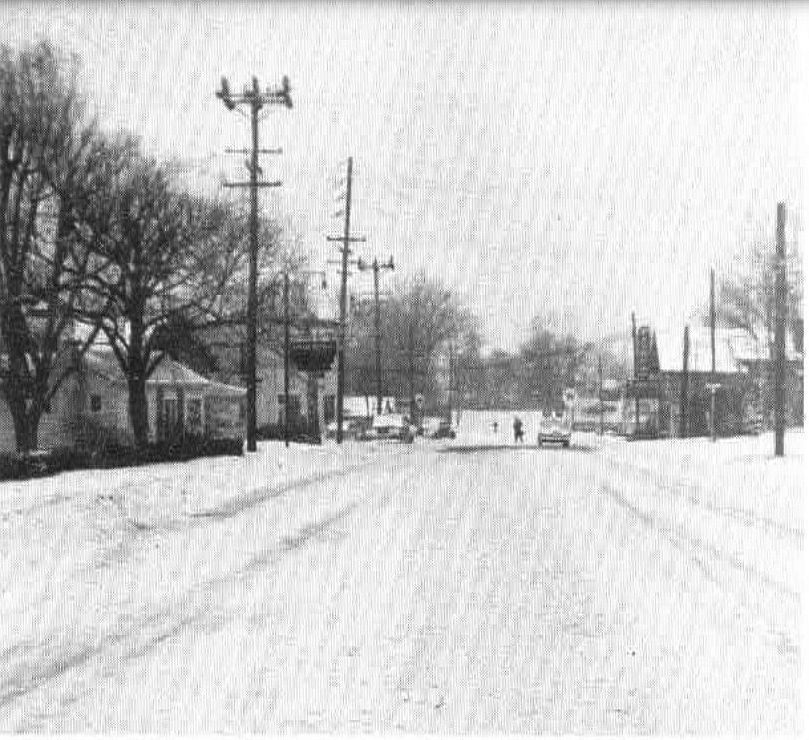
Wooster Pike in 1955, looking west from Watterson Road. The sign 
slightly left of center marks the Kream Kottage restaurant.
From A History of the Village of Fairfax by Elizabeth Steele and Patricia Kuderer

    With growing numbers of workers travelling daily between Cincinnati and the eastern suburbs, traffic became problematic between downtown and Fairfax, prompting a Cincinnati Enquirer columnist to call Wooster Pike/Eastern Avenue “a commuter’s nightmare.” The stretch of Wooster Pike between Linwood and Red Bank Road was inadequate for the volume and type of traffic it handled each day and was plagued by potholes.

     Columbia Parkway had been built as a Works Progress Administration project and opened in the late 1930s. The Parkway originally ran between Downtown Cincinnati and Beechmont Avenue. In March 1955, the Hamilton County Commission announced a multi-million dollar highway plan that included extending Columbia Parkway from Beechmont to Wooster Pike near Southern Avenue in Fairfax. 75 percent of the cost would be paid by the City of Cincinnati and the other 25 percent by Hamilton County. The extension would allow traffic to bypass the congested Wooster Pike – Red Bank Road intersection.

    I learn so much I never knew from researching this blog. Not that this is earth-shattering, but the section of Wooster Pike between Meadowlark and Southern didn’t always run where it is today. For my entire life, Columbia Parkway has run directly into Wooster Pike at Meadowlark Lane. “Old” Wooster Pike curves north to join Wooster Pike and intersect Columbia Parkway at Meadowlark. However, before the Columbia Parkway extension, it was a straight shot from Old Wooster to Wooster Pike near Southern.

1950 Map of Fairfax, from loc.gov.

     Perhaps it’s my imagination, but I can visualize where the street must have been back in the day. I took this photo slightly west of the intersection of Southern and Wooster. It seems that this would be the point where the section of road we often call Old Wooster would connect to this section of Wooster Pike:


    Below is an aerial view of the Strietmann plant (now Kellogg’s) from 1956. Wooster Pike is visible on the left side of the photograph. Part of the wooded area between Strietmann’s and Wooster Pike would later become Dragon Way.

From The Messenger, July 28, 1956

    In October 1958, Foley Construction was awarded the contract for building the Columbia Parkway extension. On October 28, Ohio Governor C. William O’Neill joined Fairfax Mayor John Dinkel and Mariemont Mayor E. Boyd Jordan at the corner of Meadowlark Lane and Wooster Pike to turn the first spade of dirt for the project.

     By December 1960, the northern side of the Columbia Parkway extension from Red Bank Road to Wooster Pike at Meadowlark Lane was open to traffic. Construction continued. Did it continue without a hitch? Of course not.

     In January 1962, the extension was complete with the exception of a 200-foot section near Southern Avenue. Seeding, sodding, and shoulder work also needed to be completed and couldn’t be done until spring. Foley Construction agreed to open the road, but only if Cincinnati and Fairfax would accept liability for structural damage and worker injuries occurring before the contract was completed.  Both Cincinnati and Hamilton County had approved the road opening. Cincinnati would pay 75 percent of the insurance premium. 

Construction of the Columbia Parkway extension west of Meadowlark Lane. 
The Frisch's Mainliner parking lot and sign are visible in the upper left quadrant of the photo.
From the January 18, 1962 Cincinnati Enquirer

    Fairfax officials did not agree to open the roadway. They feared that the traffic congestion resulting from the early opening would create a hazard. Only the two lanes on the northern side would be ready and until the project was complete, two lanes of traffic in each direction would be merging into one lane each way. The village didn’t have the money to pay its share of the insurance premium either.

This diagram from the February 8, 1962 Cincinnati Post shows the status of the
construction between Meadowlark and Southern when discussion of early opening 
of the Columbia Parkway extension began.

    Within a few weeks, though, the City of Cincinnati, Hamilton County, and Fairfax had reached an agreement to open the extension early with Cincinnati and Hamilton County paying the insurance premium. On February 22, traffic lights and road signs were installed and final cleanup was done in preparation for opening the following day. Fairfax Police Chief Jim Finan was expecting the worst and directed traffic himself. The project was completed within a few months.

     Most of the houses on Wooster Pike were disappearing and replaced with an ever-changing variety of businesses. Now we had the Main Drag I grew up with. My siblings, friends, and I had a lot of fun around the Pike as kids. In a family with both parents employed full-time, we made a lot of trips to Frisch’s Mainliner for carryout. The car wash was a goldmine for soda bottles, which we would cash in at the Pony Keg or Convenient Food Mart. We pumped our arms at passing truck drivers so they would sound their horns. My friends and I went to the Provident Bank grand opening and loaded up on the free food. My first and last shoplifting attempt was at King Kwik at the age of three or four, when I snatched some chocolate-covered cherries, only to have my mom march me back into the store to pay for them and apologize. So many memories – Clara Sallee ringing up our purchases at Atwood’s Pharmacy, the fixings bar at Burger Chef, the crossing guard, Mr. Lucking, helping us cross Wooster at Germania – it was great.

Wooster Pike between Lonsdale and Watterson
From The Chieftain, Mariemont High School, 1984

    Despite all of these nice childhood memories, Wooster Pike wasn’t exactly paradise. It was handy to have gas, auto repair, fast food, and convenience stores close at hand, but it wasn’t pretty. In 1976, the village initiated an improvement program, but, to my eye, the improvements were minor at best. There were utility wires running from one side of the road to the other and an unattractive tall chain link fence between Southern Avenue and Meadlowlark Lane. Not all of the business properties were well-maintained and neat. The road was also dangerous for pedestrians with sand and gravel-covered sidewalks directly bordering the busy roadway.

     In the early 2000s, village officials announced another Wooster Pike revitalization project. A committee of residents and businesses worked on the project and a consulting firm was engaged.  Over time, the project evolved. Obviously, most of the changes on the Draft Comprehensive Redevelopment Plan below never occurred. 

March 2003 Fairfax-Wooster Corridor Draft Redevelopment Plan

    The planned improvements were intended to make the road safer for vehicle traffic and pedestrians and to attract businesses. One component of the project was creation of a western gateway with trees, shrubbery, and brick walls announcing “Welcome to Fairfax.” The tentative plans also included eliminating some driveways on the Pike, requiring business signs to be more uniform, moving all utility poles to one side of the road, making some intersecting residential streets into cul-de-sacs, and extending Watterson south of Wooster and creating a town square. Mayor Ted Shannon said the project “should give us an identity we don’t have now. A lot of people don’t even know they’re driving through Fairfax.” The project was expected to take five to ten years and would be completed as funding became available.

        It took a few years for the Wooster Revitalization Project to get rolling. By 2010, state and federal funding had been lined up. At that point, plans included converting the road from four to three lanes (two through lanes and a center turn lane), a buffer between the sidewalks and street, new upgraded traffic lights, irrigation improvements, and, of course, making some residential streets dead ends or cul-de-sacs. In addition, aesthetic improvements were planned, to include benches, trash receptacles, planters, and a 35-foot bell tower in front of Frisch’s. The aesthetic improvements would be funded by resident and business donations and would be purchased and installed only to the extent that donations were received.

     This project might have been the most controversial in the village’s history. Germania, Lonsdale, Simpson, Carlton, and Camden were all being converted from streets that intersected with Wooster Pike to cul-de-sacs or dead ends with the intention of improving traffic flow on Wooster. Some residents on Watterson complained that the changes had increased traffic on their street and called for construction to be halted. Others felt blind-sided by the creation of the cul-de-sacs. Village officials said they made every effort to keep residents informed and had held at least a half dozen public meetings about the project since 2001. 


Mayor Ted Shannon posing with one of the new decorative street lights.
From the Eastern Hills Journal, February 10, 2010

    Ultimately, the cul-de-sacs and dead ends were constructed as planned. Wooster was reduced from four to three lanes, which caused long rush hour backups for months afterwards as commuters adjusted to the new traffic pattern. The speed limit was reduced from 35 to 25 miles per hour. Bus pull-offs were installed near Meadowlark, Watterson, and Camden, and a bus shelter was constructed at Meadowlark. New sidewalks were installed with pavers creating a buffer between the sidewalks and road. The western gateway was landscaped and a large stone sign proudly proclaiming “Village of Fairfax” was installed. Decorative street lighting was added. Pedestrian crossing lights were installed. Unused utility poles were removed and utility poles were all consolidated on the south side of the road. The aesthetic elements (benches, trash receptacles, planters) didn’t receive the amount of funding village officials hoped for, but some of these amenities can be found on Wooster Pike and throughout the village. The Watterson extension, town square, and bell tower didn’t happen.

     I won’t comment on whether this project improved traffic flow or pedestrian safety, but I will say that I think it achieved the goal of making Wooster Pike and Fairfax more attractive. It achieved the goal of informing people entering the village from the west that they are in Fairfax. It made drivers slow down to see what’s here. Can you tell when you have left Mariemont and entered Fairfax without a big “Village of Fairfax” sign at the eastern gateway? Yes, of course. Our Main Drag isn’t peaceful and tree-lined, but here you can fill your tank, buy a bike, grab a Big Boy and fries, and pick up the best doughnuts in the Cincinnati area. That is our identity. That’s Fairfax to me!

     What does the future hold for the Main Drag? As I write this, a new residential development is being constructed near the southeastern section of the Pike and drivers have voiced concern over increased traffic. Will the current configuration of Wooster Pike stand the test of time? We will see.

Wooster Pike facing east from Meadowlark Lane, 2023


Friday, March 31, 2023

The Burglar

    Law Enforcement is a heated topic these days. Although I typically try to keep my opinions to myself on this blog, I have to admit I feel bad for conscientious, ethical, community-minded police officers whose reputations are tarnished by the careless, unethical and sometimes criminal actions by others in their profession. This is why I hesitated to tell this story. It is the story of one man, a Fairfax police officer, who went from law enforcer to law breaker.

    David Lee Planitz was born July 2, 1928 to Robert and Grace Planitz. He had an older brother and grew up in eastern Hamilton County, living in Mt. Lookout, Mariemont, and Newtown. In 1942, Robert Planitz died suddenly of a coronary occlusion. In September 1945, David enlisted in the U.S. Navy and served until June 1947. Grace Planitz remarried and in 1950 David was living in Newtown with his mother, brother, stepfather, and stepbrother. Planitz married in 1951, but was divorced within two years.

    Planitz worked as a truck driver after his discharge from the Navy, but became a Cincinnati police officer in January 1952. By 1957, he was a motorcycle officer.

David Planitz modeling a new police motorcycle helmet
January 17, 1957, Cincinnati Enquirer

    A June 1958 Cincinnati Enquirer article reported that Planitz “wrenched his spine” and had been temporarily unable to move his upper extremities. According to the report, Planitz was removing his motorcycle from his garage when he noticed an oil spot on the pavement. He sustained the injury when he bent over to look at the spot. Planitz left the Cincinnati Police Department in October 1958.

     Planitz married for the second time in the late 1950s. The couple bought a house on Roberts Street in Fairfax in 1962. In the early 1960s, Planitz worked as a Hamilton County sheriff’s deputy for several months before joining the Fairfax Police Department in 1963. David Planitz’s second marriage ended in late 1963, but the couple remarried within a matter of months.

     As a Fairfax officer in the 1960s, Planitz would have been involved in some of the most high-profile cases in the village’s history, the Debbie Dappen abduction and murder, the disappearance of Johnny Hundley and Jimmy McQueary, and the Troy Lee Carr murder. He moved up in the department and achieved the rank of sergeant. Fairfax Police Chief Paul Ferrara later described Planitz as “outspoken,” but considered him “a pretty good policeman.”

     David Planitz and his wife divorced a second time in March 1970. Planitz continued to live in his Roberts Street house.

     On November 30, 1970, a citizen reported to Cincinnati police that two men were tampering with the night deposit box at the Fifth Third Bank at Madison Road and Markbreit Avenue in Oakley. Police found two men sitting in a car in front of the bank. Three heavy duty nylon ropes with hooks attached were also found the in car. The two men were arrested and charged with entering a coin receiving device. The car was registered to David Planitz.

     Interestingly, the same bank reported the theft of $200 from the night deposit box exactly one week earlier. On another occasion, the bank found nylon rope and a hook attached to a deposit bag in the night depository.

     Cincinnati and Fairfax police conducted a joint investigation and obtained a search warrant for Planitz’s home and car. It turned out that this wasn’t David Planitz’s first involvement with theft. On December 1, 1970, Planitz was charged with possession of burglary tools and burglary in relation to an October 23 burglary at Prudential Life Insurance Agency in Madisonville in which a safe was stolen. Chief Paul Ferrara suspended Sergeant Planitz pending the outcome of the case.


David Planitz, December 3, 1970 Cincinnati Enquirer

    The following day, Planitz pleaded not guilty to both charges. The judge set bond at $500 for each charge. After court that day, he apparently went to one of his favorite hangouts, the Royal Family Billiard Lounge in Oakley Square (a hop, skip, and jump from the aforementioned Fifth Third Bank), for a little relaxation. However, Cincinnati police interrupted the fun at about 6:00 p.m. when they arrested Planitz on a breaking and entering charge filed by Milford police in connection to a November 19 break-in at Ray Steidle Pontiac. On December 14, he pleaded not guilty to that charge in Clermont County Court.

     The Fairfax Police Department was apparently taking some flak over the Planitz case. The Cincinnati Enquirer published an opinion piece titled “In All Fairness” asking citizens to be fair to Fairfax police rather than ridicule them. The same department being criticized had investigated and arrested one of their own and deserved residents’ support. The piece said, "Whenever one succumbs to the temptations of condemning an entire group or class of people because of the transgressions of one of its members, he is giving in to intolerance, bias and irrationality."

     At the beginning of the new year, David Planitz was facing three felony charges and suspended from his job as a Fairfax police sergeant. If you think he stayed under the radar for a while, you would be wrong. On January 2, 1971, Blue Ash police were on a routine patrol at 5:25 a.m. when they saw a man run from the King Kwik store on Hunt Road. The police lost the man, but saw a car pull away from the scene. They stopped the car, which was occupied by David Planitz and an 18-year-old woman. They were arrested and charged with possession of burglary tools and attempted burglary.

     David Planitz submitted his resignation from the Fairfax Police Department to Chief Ferrara on January 18, 1971, saying it was for the best of the department. I doubt that many people would dispute that.

     On February 26, Planitz’s defense attorney filed a motion for dismissal in relation to the attempted burglary at the Blue Ash King Kwik, which the judge granted. The Blue Ash police had no evidence of a crime at the time they stopped Planitz and asked to see his driver’s license. Police found what they considered burglary tools in Planitz’s car, but hadn’t found evidence of an attempted burglary until later.

     In the early morning hours of March 8, 1971, Cincinnati police were patrolling Erie Avenue in Hyde Park when they noticed footprints in the snow leading to the Saybrook Tavern. An officer went to the rear of the building and saw two men run from the tavern. The men ignored orders to stop and the officer fired two shots, missing the men. One of the men, David Planitz, surrendered after a foot chase. Police pursued the other man for three miles with a canine officer and helicopter joining the chase, but he got away. The Saybrook Tavern’s safe had been breached and $950 was taken. Planitz was charged with burglary of an unoccupied dwelling. His accomplice surrendered a couple of days later; he had been a suspect because his car was found at the scene.

     In March 1971, Planitz sold his house on Roberts Street. His association with Fairfax was over; his life of crime was not.

David Planitz, March 8, 1971, Cincinnati Post

    On April 9, 1971, Planitz was a passenger in a car with another man when a Clermont County sheriff’s deputy pulled them over on State Route 125 near Batavia. Planitz was charged with possession of burglary tools. The other man was also charged with driving under suspension and driving an unsafe vehicle. Planitz was freed after posting the $10,000 bond.

     On May 2, Planitz and another man were pulled over by a Fairfax officer. Planitz was charged, again, with possession of burglary tools, as well as illegal possession of an amphetamine.

     On May 4, Planitz and four accomplices, all of whom were at least 20 years younger than he was, broke into the Heber Jones auto dealership in Middletown. They took a customer’s 1970 Cadillac, a stereo set, and tools. A safe was badly damaged, but the burglars didn’t make entry. The stolen car was recovered and the five suspects taken into custody in Bellevue in Huron County, Ohio. The five suspects were each charged with breaking and entering and grand larceny. Planitz was also charged in Bellevue for the theft of $150 in tools.

     In July 1971, Planitz pleaded guilty to the charges related to the Heber Jones robbery. The Butler County judge sentenced him to three concurrent terms in the Ohio State Penitentiary. Later, during the sentencing of Planitz’s accomplices, it came to light that at least two of them were drug dealers and another admitted to being an addict.

     In early November 1971, David Planitz was returned from the State Penitentiary to appear in Clermont County and Hamilton County courts. On November 2, he changed his plea to guilty for the charges related to the Ray Steidle Pontiac break-in. His Clermont County sentences would run concurrently with the terms imposed by Butler County. On November 3 in Hamilton County, he also changed his plea to guilty for the charges related to the Saybrook Tavern burglary. The prosecutor announced that the County was dropping the charges stemming from the May 2 traffic stop in Fairfax. 

     Planitz’s defense attorney blamed his problems on “speed and pills” and said he had been reformed in prison.

     A few years passed with no word of Planitz, who was presumably serving his time in the Ohio Pen. Unfortunately, we hadn’t yet heard the last of him. By September 1974, Planitz was facing more burglary-related charges. He was charged with breaking and entering, safecracking, and theft in connection with a July 1974 burglary at the Golden Rooster in Anderson Township. $4,000 had been taken from the safe. He was implicated by the testimony of his 16-year-old accomplice in Juvenile Court. Planitz was also arrested by Norwood police in July 1974 for possession of burglary tools when he was spotted leaving an apartment building carrying a suitcase containing acetylene tanks, a pry bar, and other suspicious items.

     Planitz ultimately pleaded guilty to charges related to the Golden Rooster burglary and the Norwood incident. His sentencing was delayed in February 1975 because he was in Veterans Hospital with a neck injury. Ultimately, he landed back in the Ohio State Penitentiary.

     David Planitz died at Franciscan Mt. Airy Hospital on September 17, 1978 at the age of 50.

     The question that plagues me as I write this is . . . Why? Why did a middle-aged veteran police officer turn to crime? Why and when did he begin abusing drugs? It all seemed to begin in late 1970. I have trouble believing that he was involved in any significant criminal activity before then – he was so very bad at burglary that he surely would have been caught. I can only hope that Planitz's accomplices, most of whom were significantly younger than him, went on to live productive lives.