Monday, July 31, 2023

Debbie Dappen

     Deborah Lynne Dappen was born April 10, 1960 to Karl and Rosemary Dappen. The Dappens also had an older child, Karl, Jr. In April 1963, Karl and Rosemary bought a home in the 3800 block of Lonsdale Street. A couple of years earlier, Karl’s parents Russell and Stella Dappen had moved into a home on Belmont Avenue in Mariemont, so the two Dappen households were within a few blocks of each other. The young family had a parakeet, a cockatiel, two turtles, and two guinea pigs.

     My parents’ first home together (and my first home ever) was across the street and a couple of houses up from the Dappen home. Although she didn’t get to know the Dappen family, my mom remembers seeing the little girl playing in her yard.

Debbie Dappen
Cincinnati Post & Times Star, August 21, 1964

    On Wednesday August 19, 1964, Debbie spent the morning outside playing with some neighborhood children. She and the other kids went home at lunchtime; Debbie went in around 12:30 p.m. and back outside to play at 1:00 p.m. Around 2:30 p.m., the mother of one of Debbie’s playmates mentioned to Rosemary that Debbie told her daughter that she and her mommy were going to grandma’s house. Rosemary responded that she had no plans to visit her mother-in-law that day and became concerned about where Debbie was. At around 4:00 p.m., Karl flagged down a Fairfax police officer and told him that Debbie was missing. Karl told police that Debbie had never wandered away before, though there was another report that she had once walked alone to her grandparents’ home.

     The concerned parents were able to give police a very detailed description of their daughter: 

She is about three feet tall and weighs about 40 pounds. Her light brown hair, slightly bleached by the sun, is cut in a short, ragged pixie style. She has large dark brown eyes and long eyelashes. . . . The girl's ears show through her hair and are fairly large. Her nose turns up, her lower lip is full, and one of her front teeth is darkened. She was wearing a dark brown pedal pusher two-piece suit with yellow trim. Her shoes were brown and white saddle oxfords. She wore pale blue stretch socks.
Debbie Dappen
Cincinnati Enquirer, August 22, 1964
 

    The Dappens’ property on Lonsdale was searched, as was Karl’s parents’ home on Belmont. Nothing was found. A door-to-door search commenced. Fairfax police, under the command of Chief James Finan, were joined by members of the Fairfax Volunteer Fire Department, the Boy Scouts, residents of all ages, and other local police departments, including the Montgomery Police and their two bloodhounds. 

Cincinnati Post & Times-Star, August 20, 1964

    My mom remembers the searchers looking in cars and in the storage bin behind our house. Porch lights were on for blocks around the Dappen home. At around midnight, Rosemary came out and asked searchers if the bloodhounds had picked up a scent, but they hadn’t. No trace of Debbie was found during the overnight search.

Cincinnati Post & Times-Star, August 20, 1964

    There were several reported sightings of Debbie. 10-year-old Scott Rickey, who lived at the corner of Watterson and Elder and knew Debbie, said he caught a glimpse of her at Bramble Park around 4:00 p.m. Wednesday. 10-year-old Kenny Aichholz said he thought he saw her at the Fairfax School playground at 3:00 p.m. on Wednesday. A Madisonville teenager said she saw Debbie at the Madisonville School and knew her because she taught her how to swim at the Bramble Pool. However, Rosemary said Debbie didn’t know how to swim and had never been to the Bramble Pool. A Milford man said he searched a sewer under Wooster Pike and saw a piece of brown fabric with yellow edging atop a log, but the log floated away. A Terrace Park teenager reported seeing a body floating in the Little Miami River, but police found nothing.

     Helen Guthrie, who lived on another corner of Watterson and Elder, reported hanging laundry in her backyard around 2:45 p.m. on Wednesday when she said she saw Debbie across the street outside of the Watterson Market. She knew Debbie, because she had taught her in Vacation Bible School at Fairfax Presbyterian Church a couple of months earlier:

I'm pretty positive that was Debbie. I recognized her at the time and didn't think any more about it. A lot of children wait outside the store while their mothers are inside. It wasn't until that evening that my daughter reminded me the store was closed that afternoon. I wish I had remembered it then and called Debbie over. I didn't call to Debbie but I doubt that she would have answered me anyway. She's a bashful child and doesn't make up to people very quickly.


Helen Guthrie and the Watterson Market. The arrow indicates where she said saw
Debbie Dappen. From the Cincinnati Enquirer.

    The search throughout Fairfax continued on Thursday.  Because of the possible sightings in Madisonville, Cincinnati Police searched the areas of Madisonville and Hyde Park that bordered Fairfax, including the wooded area between Murray Avenue and Bramble Park.  All of Fairfax was searched, including the entire length of Little Duck Creek. 

Volunteers searching near Columbia Parkway and Red Bank Road.
From the Cincinnati Enquirer, August 21, 1964

    At 2:30 p.m., Fairfax officials dismissed the volunteers because there was no part of the village that hadn’t been searched. The authorities would handle the search going forward. There had been absolutely no trace of Debbie Dappen.

     Karl Dappen appeared at a press conference at the Fairfax Municipal Building. He believed Debbie was being held against her will, saying, "I plead to you as a father - to anyone who has Debbie - please return her . . . return her safely . . . so the family might be whole again. She is just a little four-year-old girl." He thanked everyone who had supported his family, and the police, firemen, and volunteers who had searched for Debbie.

Karl Dappen at press conference.
Cincinnati Enquirer, August 21, 1964

    Chief Finan shared his thoughts about the case with the media:

I have found the children who played with Debbie Wednesday morning. I know who she was with until she went into lunch about 12:30. I have her pegged until then. But I can't find any children who played with her in the afternoon. I just wonder why I can't find anyone who saw her after she ate lunch? I'm pretty sure she was seen about 2:45 p.m. at the grocery store at the corner of Watterson and Elder by Mrs. Guthrie. Mrs. Guthrie's description of the clothing the girl was wearing tallies with the clothing Debbie was wearing and Mrs. Guthrie had taught Debbie in church school. That's a half block north and a block east of the Dappen home on Lonsdale. I'm satisfied that was Debbie, but where was she before that and where was she after that? Who was she with?

    To add to the Dappens’ distress, they were receiving anonymous phone calls. No one would respond when they answered the calls, though at least once there was a baby crying in the background. Chief Finan enlisted Cincinnati Bell to try to trace the calls.

     Finally on Friday August 21, there was a break in the case when 13-year-old George Rickey, Jr. and a friend reported finding a shoe around four feet inside a pipe near Little Duck Creek at the Watterson Bridge, a brown and white saddle oxford. They took the shoe to Rickey’s sister, Edna, who often played with Debbie Dappen, who said it was Debbie’s shoe. They then took the shoe to Chief Finan. The shoe was taken to the Dappens, who identified it as Debbie’s.

George Rickey (left) and friend showing where they found Debbie's shoe.
Cincinnati Enquirer, August 22, 1964

Debbie's brown and white saddle oxford.
Cincinnati Post & Times-Star, August 22, 1964

    After the shoe was found, one of the reporters covering the story saw George Rickey look into an opening under his front porch. He reported what he saw to Chief Finan. (According to a comment left in 2020 on a story by Johnny Carroll about this case on Mariemont High School’s The Blueprint [Fairfax: The Summer of '64], WCKY radio’s Larry Roberts was the reporter.) 

    Upon news that a shoe had been found and identified as Debbie’s, searches began anew. Fairfax firefighters, with the assistance of machinery and personnel from Crumley, Jones & Crumley of Deer Park, Ohio, pumped out a pool in the creek near where the shoe was found. Bloodhounds were again called in. Reverend David Hadden, the Dappens’ pastor at Fairfax Presbyterian Church, led a group of men on a door-to-door search between the Dappen house on Lonsdale and Karl’s parents’ home on Belmont. Nothing more was found.


Searchers draining a pool in Little Duck Creek after Debbie's shoe was found.
Cincinnati Enquirer, August 22, 1964

    Cincinnati Enquirer crime reporter, Frank Weikel, had the kind of access to law enforcement during this investigation that one can’t imagine in today’s world. His reporting gives a lot of insight into the conclusion of this case.

Frank Weikel, Cincinnati Enquirer, August 22, 1964

    Weikel, Chief Finan, and Mayor Ronald Cribbet reasoned that 13-year-old George Rickey must have been responsible for the crime. He had found Debbie’s shoe in an area that had been searched at least twice before. There was also the reporter’s tip that Rickey had been seen looking under his front porch. Finally, some residents had reported to police that Scott Rickey, George’s younger brother, said that George had found Debbie’s shoe on Thursday night, not Friday.

    At 11:00 p.m. on Friday August 21, after most residents were in for the night, Chief Finan, Patrolman Harry Smith, and Frank Weikel went to the Rickey house on Watterson to question the family and ask to search the house. Alicia Rickey, George’s mother, answered the door and spoke to the men on her front porch. She consented to a search and suggested they start in the basement. Chief Finan said that the search would begin under the porch. Weikel was the youngest of the three men and climbed through the small opening under the porch while Finan and Smith lit the area with their flashlights. He crawled to the other side of the porch and moved a couple of pieces of wallboard and saw a child’s bare arm and midsection. Frank Weikel found Debbie Dappen’s body.

Frank Weikel showing the opening under the Rickeys' porch.
Cincinnati Enquirer, August 23, 1964

    Chief Finan called in Cincinnati Police homicide detectives and the Hamilton County Coroner’s Office. George Rickey, Sr. was now out of bed and dressed. Mrs. Rickey went to awaken George, Jr. Initially, George, Jr. said he didn’t know how Debbie’s body had gotten under the porch. Sgt. Russell Jackson and Detective Wilbert Stagenhorst of the Cincinnati Police arrived on the scene. George, Jr. was instructed to get dressed and Chief Finan, Sgt. Jackson, Detective Stagenhorst, and Frank Weikel took him to the Mariemont Police Station for questioning. Patrolman Smith went to the Dappen home to take them to the Fairfax Police Station; Chief Finan wanted to be sure they were notified of Debbie’s death through official channels.

Detective Stagenhorst, George Rickey, and Sgt. Jackson.
Cincinnati Enquirer, August 23, 1964

    Three minutes into the questioning, Rickey confessed to killing Debbie Dappen. Rickey said he was among the children playing near the Dappen home on Wednesday morning. The kids all went home around noon for lunch. He said he returned to Lonsdale after lunch and Debbie was playing alone on the sidewalk. He said that he asked Debbie if she wanted to go to his house to play hide and seek and she agreed. No one was home at the Rickey house. He led the little girl to his bedroom and attempted sexual advances. Debbie screamed. Rickey got a butcher knife from the kitchen and stabbed Debbie in the abdomen. After he stabbed her, he strangled her. After her crying and screaming stopped, Rickey carried her to the bathroom, washed the blood from her body, and placed a Band-Aid on the stab wound. He carried Debbie’s body out the side door of the house. He placed her under the front porch, dragged her to the other side, and covered her with debris.


George Rickey
Cincinnati Enquirer, August 22, 1964

    When he went searching for Debbie with his friend on Friday, Rickey was carrying her shoe in his pocket.

     The police officers (and Frank Weikel) took the boy back to his house, where he showed them the knife he used to stab Debbie. They then instructed Rickey to tell his mother what he had just told them. Rickey said, “I did it, Mom, I killed her.” Mrs. Rickey embraced him and asked him why. He replied, “I don’t know.” Police took George Rickey, Jr. into custody. The coroner’s office then arrived on the scene, completed their investigation, and removed Debbie’s remains.

    At 2:00 a.m. Saturday, the police and Weikel went to the Fairfax Police Station, where Rosemary and Karl Dappen were waiting. They had been crying and were holding hands. They were aware that Debbie was dead, but the police officers filled them in on the rest. Rosemary said, “I know it doesn’t matter now, but was her face marked up?” She was told it was not. “Take me to my baby,” she said, “I want to see my baby now. Take me to her now.” As Karl tried to comfort Rosemary, police explained that the coroner’s office had taken Debbie’s body to the morgue.

     The coroner’s office said that Debbie had been dead at least 48 hours when found and determined that suffocation was the cause of death. There was no evidence of sexual assault. The stab wound in the abdomen would not have been fatal, had it been treated properly.

Chief James Finan viewing evidence.
Cincinnati Enquirer, August 23, 1964

    Back in those days, the third weekend in August was the social event of the year in Fairfax, the Firemen’s Festival. In 1964, the timing couldn’t have been worse. Residents awoke to learn about the murder of a Fairfax child at the hands of another Fairfax child, and then later in the day made their way to the festival. Volunteer firefighters who had spent the past two and a half days searching streets, woods, creek, pipes, and sewers were now staffing booths at an “abbreviated” festival. Parents, who no doubt didn’t let their children out of their sight, took them to enjoy some rides, eat cotton candy, and maybe win a goldfish. 


Cincinnati Enquirer

    The festival was an important fundraiser for the all-volunteer department. Fairfax Fire Chief Kenneth Kuhner said that the rides and concessions had been arranged a year in advance. Chief Kuhner said, “It wasn't our desire to go ahead with it, but we did have commitments."    

Cincinnati Enquirer

    The visitation for Debbie Dappen was held at Thomas Funeral Home in Madisonville on the evening of Sunday August 23 and hundreds of people attended.

     Debbie’s funeral was held at Fairfax Presbyterian Church on Monday August 24 with Rev. David Hadden officiating. An honor guard of 200 Fairfax children was planned. Chairs and a loudspeaker were set up outside the church to accommodate as many people as possible. Rev. Hadden read a statement from Rosemary Dappen requesting “malice toward none” and that no one “persecute” the Rickey family.  Rev. Hadden said, "This courageous mother has nobly set the pattern for all of us." Debbie was buried at Mount Washington Cemetery.

Debbie Dappen's funeral at Fairfax Presbyterian Church.
Cincinnati Post & Times-Star, August 25, 1964

    The Dappen family requested that memorial donations be made to Fairfax Presbyterian Church. Rosemary suggested a room where parents could take their fidgety children and still be able to follow the service. At the time of the funeral, $1,000 had already been raised to build a soundproof room with a glass window and speaker at the back of the sanctuary. Joseph E. Smith, the architect who designed the church over 20 years earlier, donated his time to design what would later be called the “Debbie Dappen Crying Room.”

     Within a week of the discovery of Debbie’s body, the Dappens had received hundreds of letters of condolence from around the country. Rosemary was trying to answer each letter individually in appreciation to the people who took the time to reach out to them. The task also served to keep her mind occupied. Some letters contained contributions.

     Rosemary and Karl shared their thoughts about what they had been through. Rosemary said the hardest part was “the waiting and the uncertainty. Every time the phone rang, I almost jumped out of my skin. Then that Thursday I knew that she was gone. And after they found her, I felt a sense of relief. At least I knew where she was . . . that she was here with us and not off somewhere where we might never see her again, or know what happened to her."

     Karl said, "That first night was worst for me, I think. It's hard to say. But I remember the search Wednesday night the clearest. It's like a dream now, but I remember all the people milling around, the dogs, and all those flashlights."

     Rosemary said, "Everywhere I look I see something that reminds me of Debbie. There are some scribblings on the front porch that Debbie made with her crayons . . . I'll never paint that porch. Most of her things are still upstairs. I couldn't part with them . . . but I still can't face them."

     The weekend after George Rickey, Jr. was taken into custody, Rev. David Hadden twice took George and Alicia Rickey to visit him. In the coming weeks, Rickey underwent physical and psychiatric testing. The Juvenile Court retained jurisdiction over his case and in December 1964 found him guilty of delinquency in the murder of Debbie Dappen. The judge turned him over to the Ohio Youth Commission with the recommendation that he remain in custody until the age of 21.

     This was not Rickey’s last brush with the law. In 1970 at the age of 19, he was serving time at a halfway house in Columbus when he was charged with assault with intent to rob. He worked at a hospital during the day and attempted to rob a nurse at knifepoint. He was sent to the Lima State Hospital, then returned to Columbus, where he was on probation until November 1972.

     He then returned to Cincinnati and worked as an orderly at the Cincinnati Mental Health Institute. On March 9, 1973, Rickey, then 22, knocked on the door of a Butler County woman’s home, asking to use her phone because he was having car trouble. Upon entering her home, he choked, bound and gagged her, and forced her into a sex act. He left the woman bound and gagged, but she was able to free herself quickly and call police with a description of his car. The police arrested him five minutes later. He was convicted of sodomy, malicious entry, and assault with intent to rob and sent to the Mansfield Reformatory. He first went before the Parole Board in March 1974 and wouldn’t again be eligible for parole until 1979.

     Upon hearing of Rickey’s arrest on the television news, Karl Dappen contacted Frank Weikel at the Cincinnati Enquirer to express his “horror and shock that George Rickey has been returned to society.”

     I’m not sure how much longer the Rickey family lived in Fairfax. Life couldn’t have been easy for them in the village or in that house. Rosemary and Karl Dappen sold their Lonsdale home in December 1969.

     Even though this horrific case happened less than 60 years ago, society has changed a lot since then. We have a tendency to look back at stories like this with our modern-day sensibilities and judge the actions and decisions of the people involved. I have to remind myself not to indulge in this type of judgement.

     Instead, I want to try to glean some good from this story. Our community came together to search night and day for a little girl most residents didn’t know. The Fairfax Civic Association announced that they would drain their treasury to establish a fund for information leading to Debbie’s whereabouts. Volunteers from the Red Cross Disaster Unit, without request, came to the village to offer equipment and manpower. Village residents brought coffee and sandwiches to the firehouse for the searchers. Fairfax Police, as well as law enforcement from other local agencies, spent hours searching and investigating. The Fairfax Volunteer Fire Department searched tirelessly for Debbie. Rev. David Hadden of Fairfax Presbyterian Church ministered to the Dappen family, led a search for his little congregant, supported the Rickey family, and officiated Debbie’s funeral. Finally, Rosemary and Karl Dappen showed dignity and empathy in a situation that no parent wants to ever think about facing.


Friday, June 30, 2023

The Battle for Dublin Springs

     If you have read previous articles on this blog, you know that Fairfax has sometimes had an image problem. In the 1920s, local government officials called Fairfax a “rural slum” and a “settlement of poor persons in little homes.” Back then, we were known as “Dogtown.” In the 1950s, a school board member from Mariemont complained that residents of other areas of the district were “paying the freight” for the children of Fairfax. A few years ago, someone even posted on the Fairfax, Ohio Wikipedia page that we were “the armpit of the Mariemont School District,” an entry that has since been deleted. If you have lived here very long, you know. You have heard it all before.

     Before we get on our high horses, though, there are a couple of areas within the village that some residents have at times overlooked, ignored, and, frankly, looked down upon. One of those areas is Dublin Springs, the subdivision that includes the south side of Wooster Pike, Spring Street, Eleanor Street, Mary Street, Arrow Point Way, and, at one time, Riverview Drive.

Hamilton County CAGIS map. Dublin Springs is on the southern side of Wooster Pike

    Both of my parents lived on Spring Street for a while when they were children. More family members and friends lived on Eleanor and Spring Streets through the years. In the early 1970s, my aunt watched my sister, brother, and me at her family's Spring Street home while my parents were at work. I have a lot of childhood memories of playing in the area with my cousins, like hanging out in the clearing at the end of Riverview Drive, walking to King Kwik for some candy, and dumpster diving at the Dragon Way office buildings. Perhaps the most iconic childhood experience in that area in those days, though, was going to a rear fence of Keebler (previously Strietmann’s and now Kellogg’s) and calling for the workers to toss you some cookies. I have been told in earlier days they would give away bags of broken cookies. However, I seem to recall receiving full, intact packages.

     As far as I recall, no one called the area Dublin Springs. I called it “the other side of the Pike,” until my mom told me that sounded derogatory. I never thought of it being derogatory, though; I thought it was just a description of where it was located in relation to the rest of Fairfax. It was a secluded little neighborhood and, to me, had sort of a rural feel.

     Enough of my reminiscing!

     The Dublin Springs subdivision was platted in April 1913:

Dublin Springs plat, Hamilton County Recorder's Office

    In an August 1913 newspaper ad, Robert Cresap, the real estate developer behind Dublin Springs,  described Lot 1 in the subdivision as follows: “It has seven springs, fine sand and gravel bank; fine for trucking; make a fine chicken or truck farm.” Cresap also suggested the location for a grocery for the small, but growing, Fairfax Subdivision, or a hotel or roadhouse for the 300 to 500 drivers who passed the location each day. Instead of becoming a farm, grocery, or hotel, Lot 1 was divided into smaller lots and became Spring Street and the western portion of Eleanor Street.

     Other than the Joseph Ferris House, the original Dublin Springs structure (see The Joseph Ferris House), the oldest houses I found in the subdivision were built on Wooster Pike and Mary Street in 1915. One of the Wooster Pike houses is still standing and the other, after several additions and modifications, is now Mac’s on the Pike. The Mary Street house has since been torn down. There may have been earlier homes in the subdivision that are no longer in existence.

     The first public school in Fairfax opened in Dublin Springs in 1918, at the corner of Spring Street and Wooster Pike, where Honest-1 Auto Care is now located. The most prominent of the springs in Fairfax was located behind the school and was the source of drinking water for the school and surrounding neighborhood. And, yes, Spring Street received that name because of the nearby spring.

     In the 1920s, the Fairfax and Madison Heights Subdivisions received water, sewage, and gas lines. I haven’t been able to determine exactly when the various sections of Dublin Springs received water and gas lines. My mom remembers that her family had water and gas service on the north section of Spring Street when they lived there in 1949. However, a couple of women who lived at the south end of Spring Street reported in a 1951 Cincinnati Times-Star article that they did not have water service and had to get water from neighbors. Dublin Springs did not have storm or sanitary sewage service like the rest of the village; their homes had septic tanks. Also, Dublin Springs didn’t receive door-to-door mail delivery until the mid-1950s, after the rest of the village.

Cincinnati Post, April 9, 1942. There were no storm sewers to handle the water
from heavy rains.

    In 1955, Fairfax residents, including those in Dublin Springs, voted by a 9 to 1 margin to incorporate as a village. The following year, voters approved a $1.4 million bond issue for street improvements. By 1961, nearly $1.1 million in bonds had been issued when the Ohio Supreme Court stopped the village from issuing any additional bonds for the street improvement project until the village’s tax duplicate was higher. Village Clerk Virmorgan Ziegler speculated that the remaining $300,000 might not be enough to complete the project anyway, since construction costs had increased in the past five years. No improvements had been made to the Dublin Springs Subdivision.

     In December 1961, Mayor Ralph Mitchell announced a plan to apply for federal urban renewal funds for redevelopment of Dublin Springs, proudly announcing that Fairfax would be the first suburb in Ohio to do so. The federal Housing Act of 1949 sparked the urban renewal movement, providing for "the elimination of substandard and other inadequate housing through the clearance of slums and other blighted areas, and the realization as soon as feasible of the goal of a decent home and a suitable living environment for every American family." It sounds like a good idea, I guess, unless you live in the area of the proposed renewal and are happy there.

Fairfax Mayor Ralph Mitchell from 1959 campaign advertisement.

    Of Dublin Springs, Mayor Mitchell said, "Most of the houses there are substandard, although there are some that meet standards or are above standard." He said it was “impractical to make the improvement for residential use” and that the area was better suited to commercial or industrial use. The plan would involve moving the 50 or so families in Dublin Springs. Mitchell said the federal government would probably insist that the displaced residents be relocated to other homes in Fairfax. He estimated an urban renewal plan for Dublin Springs would cost around $400,000. The idea was only in the planning stage, though, and council hadn’t yet voted on it.

     On December 12, 1961, Mayor Mitchell met with some concerned Dublin Springs residents at the home of Norman Yeager on Spring Street. These residents did not support the project and had no interest in moving. The residents expressed their frustration because they were told that they would get new sewers and streets if they incorporated with the rest of the community, but hadn’t. Mr. Yeager said, “Then we voted for a bond issue to improve the village’s streets, but all of the improvements have been on the other side of town. We haven’t gotten any, but our taxes went up . . . to pay for the bond issue.” Mitchell explained that the village had already spent all of the funds from the bond issue elsewhere in the village and that improvements to Dublin Springs streets would be too expensive. Despite the Dublin Springs residents’ opposition, Mitchell said the village would likely proceed with the project.

     Over 30 Dublin Springs residents attended the December 20, 1961 council meeting to voice their opposition to the urban renewal plan. Nevertheless, several weeks later, council cleared the way for federal officials to conduct a field survey of Fairfax for urban renewal purposes. The council vote was three to three, with Mayor Mitchell casting the deciding vote in favor of proceeding with the plan. Council applied for a federal grant for a study of Dublin Springs. The study would take around a year to complete.

     In April 1962, Fairfax council member Joseph White, at the urging of Arrow Point Way resident Ralph Meisberger, introduced a motion to drop the urban renewal plan. Again, the council vote was three to three with Mayor Mitchell casting the deciding vote to defeat White’s motion.

     In early May, Fairfax received federal approval for the urban renewal project. With this, the village was eligible to apply for a federal planning grant for a land use study of Dublin Springs. Once the study was competed, the village would need to decide whether to rehabilitate the area, clear and redevelop the area, or drop the project altogether.

     Some village officials wanted the urban renewal project placed on the ballot to gauge resident sentiment on the issue. This was never necessary, as it turns out. Council member Edward Steele, who had been a staunch supporter of the urban renewal project, resigned from council on May 14, 1962 when he accepted a state civil service job.

     At the May 15, 1962 council meeting, Joseph White introduced a motion to not move forward with the federal urban renewal project. The motion passed by a three to two vote. White and fellow council members Harry Davis and Wayne Nichols voted to abandon the project. Ronald Cribbet and Charles Schuler voted against the motion. The Cincinnati Enquirer reported that Fairfax’s rejection of federal urban renewal funds was believed to be the first in the history of the program.

     Joe White acknowledged that the grant the village had rejected was only for a land-use study, which could take at least a year, but regarding the Dublin Springs residents he said, “How would you like this thing hanging over your head for a year?” He said he was against relocating the Dublin Springs residents. He said he was against always “running to the government to solve a problem” and also believed that the power of eminent domain had gone too far, both in Fairfax and elsewhere. He felt that efforts to rehabilitate the area should be handled locally, rather than at the federal level. White proposed a committee to study installation of sewer lines and construction of new streets with funding supplied by a new bond issue. White said, "I think if those people got sanitary sewers and new streets, that would be an incentive to them to improve their property."

     John Pfister, a Dublin Springs resident and opponent of the urban renewal proposal, was appointed to council to fill the vacancy created by Edward Steele’s resignation. The anti-federal urban renewal faction on council now held a four to two majority. In June 1962, Mayor Mitchell appointed a committee of three council members to study improvements to Dublin Springs. Later that month, Ralph Mitchell resigned as mayor effective July 1, 1962 because he was moving out of the village. Council member Ronald Cribbet was appointed mayor.

     In July, council announced that a $175,000 bond issue for sewer, street, curb, gutter, and sidewalk construction in Dublin Springs would be on the November ballot. Ralph Meisberger chaired a house-to-house campaign to garner support for the issue. The bond issue passed. In December the village also asked county commissioners for $39,000 for sanitary sewer construction. Village officials wrote, "It is our belief this sewer should have been constructed many years ago when other sewers were installed in the area by the county, and therefore constitutes a responsibility of the county, irrespective of the fact that the village of Fairfax is now incorporated."

    Of course, projects like this feel like they take forever. Initially, the village had three sewer options to evaluate. Then in March 1964, village officials reported that they were still working on one more easement in Dublin Springs in order to begin work. In May, the village awarded the $112,000 project to the low bidder, Carter Construction, and work soon began. Unfortunately, in October 1964, two Fairfax boys disappeared and there were concerns that they may have been buried in an open sewer trench on Eleanor Street. The trench was re-excavated and nothing was found. In February 1965, the Hamilton County coroner and village residents expressed concern that not enough of the trench had been searched. In March 1965, more of the trench was re-excavated with no trace of the boys.

From the March 25, 1965 Cincinnati Enquirer

    Finally, Dublin Springs received storm and sanitary sewers and new streets, sidewalks, curbs, and gutters.

     Since then, several of the homes in the Dublin Springs have been torn down. New ones, including the condominiums on Arrow Point Way, have been built. In the late 1970s, Keebler purchased all of Riverview Drive and the houses at the south end of Spring Street, including my uncle and aunt’s home, and razed them.

     As I was writing this article, I realized that it had been around 40 years since I had been to Spring and Eleanor Streets. I visited on a weekday in the spring. It was quiet and a couple of residents were taking advantage of the nice weather to do some work in their yards. 

Eleanor Street looking east from Spring Street, 2023

Eleanor Street looking west from Spring Street, 2023

Spring Street looking north from Eleanor Street, 2023

    The area was much the same as I remembered it, until I got to the south end of Spring Street. Several homes were gone, including my uncle and aunt’s house and the Whitney house next door, replaced by a parking lot:

Southern end of Spring Street, 2023

    The former Riverview Drive, which ran perpendicular to Spring Street at its southern end, was locked behind the Kellogg’s gates:

Looking east in the area where Riverview Drive once was, 2023

    Although it is sad to see the changes made since my youth, I’m glad that this little neighborhood within a neighborhood is still thriving. Below are pictures from the 2023 Eleanor Street Fourth of July block party:


Block party photos courtesy of Tonya Moore.


Wednesday, May 31, 2023

The Grocers

     I originally planned this article to be a profile of several of the early business owners in Fairfax. However, in the course of my research I realized that I had found much more information about one business and its owners than I had for others. It was a business that I didn’t really know anything about until I started researching Fairfax history because Yochum’s Food Shop was out of business by the time I was born.

     Ethel Mae Carr was born in 1900 in Highland County, Ohio and Karl Everett Yochum was born in Highland County a year later. This was a rural area and both Ethel’s and Karl’s families had farms. Ethel’s father also managed a general store. In 1924, Ethel and Karl married in Highland County, then moved to the Cincinnati area. They initially lived in Madisonville, then moved to Norwood. By 1930, Karl was managing a grocery store in Madisonville.

     In October 1931, a man named William Lopacher opened a grocery at 6012 Wooster Pike in Fairfax. Within a couple of months, he sold the store to Karl and Ethel Yochum.

     Grocery shopping back then was much different than it is now. Stores were more specialized. There were dry goods stores, butcher shops, fish stores, and dairy dealers. Also, although a few self-service stores began around 1916, most stores were full-service, meaning that a customer would place their grocery order by phone or provide a shopping list and clerks would prepare the order for pickup or delivery. By the 1930s, some stores started offering both groceries and meat, and supermarket chains, like Kroger and Albers, were starting to grow in popularity.

Interior of Yochum's Food Shop from A History of the Village of Fairfax 
by Elizabeth Steele and Patricia Kuderer. It appears that Karl and Ethel are pictured
at right and the store's butcher at left.

    I would be remiss if I didn’t mention that there were other groceries in Fairfax. I do remember some of the other ones. The Fairfax Food Shop (which had a number of names and owners over the years) was located at the corner of Germania and Hawthorne, where the municipal parking lot is now. Watterson Market (known as Clark & Melvin in earlier days) was located at Watterson and Elder where Fairfax Lock and Key is now. Although it was technically in Mariemont, Brueckner’s was at the corner of Wooster and Settle. My family patronized all three of these stores. There were apparently even more grocery stores in the early years.

     Although the Yochums set up shop in Fairfax, they never, to the best of my knowledge, actually lived in Fairfax. In the late 1930s, they purchased a home on Settle Road in Mariemont. They were very much part of the Fairfax community, though. Yochum's sponsored local baseball teams and Karl even played on a Fairfax team himself. Karl was on the Plainville Rural School District Board of Education from the 1930s to the early 1940s. During his time on the Board, Plainville High School (now Mariemont Elementary) was constructed.

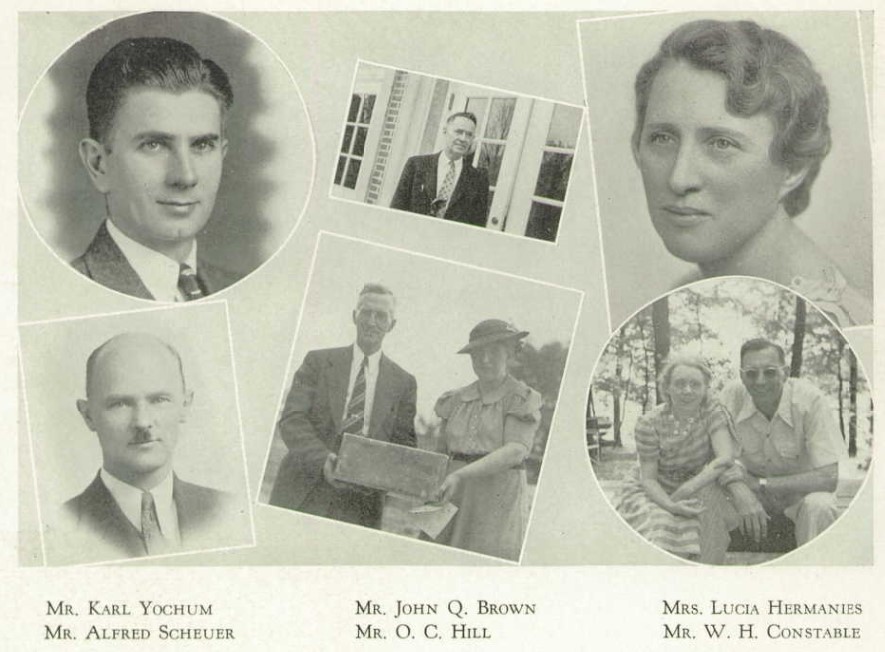
Karl Yochum (upper left) and other members of the Plainville Rural School District Board of 
Education from the 1941 Plainville High School Yearbook

    Now, Fairfax history nerd that I am, what really convinced me to do an article on the Yochums was having an opportunity to view some great old relics from the store. Some of these are receipts from other historic Cincinnati-area businesses with which Yochum's did business. Here are a few:

A 1937 receipt from our own Fairfax dairy, The J. H. Berling Dairy Products Company.


Do you remember Rubel's Rye Bread? 


A 1932 receipt from The Niser Ice Cream Company


Does anyone remember Mannino's Groceries in Madisonville? They were among 
Yochum's suppliers.


A Strietmann Biscuit Company receipt (for Toyland Animals and Zesta Crackers)
before Strietmann relocated to Mariemont. 


"Put it on my account!"
This appears to be a listing of Yochum's credit accounts from August 1937.


Remnants of an egg carton from Yochum's Food Shop.


Paper grocery bag from Yochum's Food Shop

    In 1946, the Yochums remodeled their store, giving it a brighter appearance. The store got a good cleaning and the walls were painted. A new 18-foot display counter was installed, giving customers a better view of and access to the merchandise. The biggest change was that the store converted to self-service. However, Yochum’s continued to offer clerk service to anyone who wanted it and still offered delivery three days a week.

Ad for Yochum's Food Shop from The Messenger, March 22, 1946

    Karl was an active member of the Cincinnati Retail Grocers and Meat Dealers Association for many years, serving as a director, vice president, and then president. Among the Association’s programs was the popular Pure Food Show that was held for two weeks at the Cincinnati Zoo each summer. The show featured booths, performances, cooking and homemaking classes, fashion shows, baby contests, and live radio broadcasts. Karl was often on the Show Committee.

     Ethel was a member of the Ladies’ Auxiliary of the Retail Grocers and Meat Dealers Association and served as president of the Cincinnati, Ohio State, and National organizations. As a member of the Ladies’ Auxiliary, Ethel participated in activities including selling war bonds on Fountain Square and delivering Christmas toys to patients at Children’s Hospital.

     The Yochums were also members of Fairfax Presbyterian Church. Karl helped to organize Boy Scout Troop 272, which was sponsored by the church. Karl was also involved in the Presbyterian Men of Cincinnati and was the director appointed by the Fairfax Church.

     After Fairfax incorporated as a village in 1955, business owners organized a Chamber of Commerce with Karl Yochum as the first president. He was also a director of the Fairfax Welfare Association. When the Fairfax Volunteer Fire Department was organized, Karl joined. Later in life he was a member of the Fairfax Senior Citizens Club.

Harry Nutick (left) and Karl Yochum (right) cleaning the fire engine
after a run. From the Cincinnati Post and Times Star Volunteer Firemen's Edition, 1960.

    In March 1957, Yochum’s had a 25th anniversary celebration, which included giveaways. A local newspaper, The Messenger, published an article about Karl, saying "He has seen the same persons come in for a sucker or a bubble gum, later pencils and tablets for school, and eventually a basket of groceries for a new family."

Ad from The Messenger, February 17, 1956


    The grocery industry was evolving and between 1948 and 1963, the number of supermarkets in the United States tripled. Small independent local grocers like Yochum’s found it hard to compete with large chains. I’m not sure if it was a financial or personal decision, but Karl and Ethel Yochum closed their grocery store in 1960. Within the next 15 to 20 years, the other small groceries in our community – Fairfax Food Shop, Watterson Market, and Brueckner’s, also closed.

     Karl remained active in the Fairfax community and he and Ethel continued to live on Settle Road in Mariemont. In May 1974, the Yochums celebrated their 50th wedding anniversary with a dinner party at Ethel’s brother’s home back in Highland County.

     Ethel Yochum passed away on January 15, 1976. Services were held at Fairfax Presbyterian Church and she was buried back home in Highland County. In September 1977, Karl sold the home on Settle Road and moved back to Highland County. Fairfax Village Council passed a resolution of appreciation to recognize his service to the community.

     Karl remained active after he moved to Highland County, joining the Hillsboro Lions Club and even becoming the Class C champion of the Highland County Senior Citizen Eight Ball Billiard Tournament at the age of 84. In the late 1980s, Karl’s health began to fail. He passed away on March 24, 1990.